

The fake was convincing because it looked boring.
No cinematic lighting. No UFO in the sky. Just a screenshot of a chat thread, a cropped invoice, a “normal” headshot. That’s the point. The best fakes borrow the visual language of everyday life: messaging apps, receipts, IDs, profile photos. They move fast because people don’t want to slow down and interrogate something that feels familiar.
But the tools that make these images easy to produce also leave fingerprints. And when the stakes are high, those fingerprints matter.
Before the cases, it’s worth stating the obvious: not every synthetic image is malicious. People use generators for jokes, storyboarding, UX mockups, and social skits. The trouble starts when the same formats get used to “prove” harassment, fraud, or a scandal that never happened.
Case 1: The “HR Is Furious” Chat Screenshot That Sparked a Workplace Blowup
It began as a Slack screenshot passed around a small company like a lit match. The image showed a manager supposedly writing, “We need to replace her this week,” followed by a few lines that made it sound like a coordinated firing plan. Employees were upset. A couple of people started saving copies “in case this goes legal.”
The first red flag was social, not technical: nobody could find the message inside Slack. No permalink. No channel history. Just the screenshot.
A quick internal review found the screenshot had odd UI spacing. A missing pixel here, a slightly off alignment there. That kind of “almost right” is typical of template-based fake chat tools, which can produce convincing replicas of messaging interfaces in minutes. One of the most common use cases is a fake whatsapp chat style mockup, but the same idea applies to Slack, Discord, iMessage, and the rest. You pick a platform skin, type the lines, export an image.
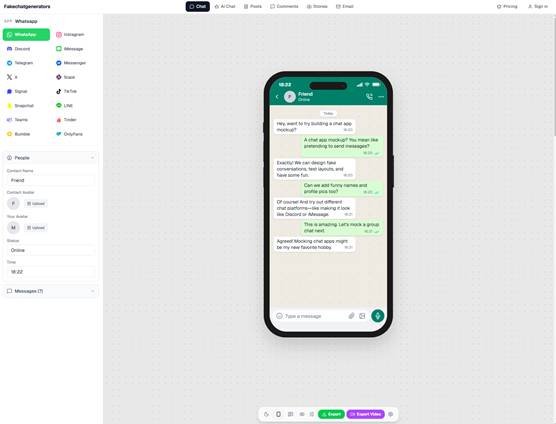
fakechatgenerators.com lets you mock up chat screenshots across 16 platforms
The company’s IT team escalated it because the accusation was serious and reputations were already being burned. When they ran the image through forensic checks, they found metadata inconsistencies and compression patterns that didn’t match typical Slack captures from company devices. The screenshot was a manufactured artifact, not a capture of a real thread.
Outcome: the workplace conflict cooled down, but not cleanly. The employee who spread it claimed it was “sent to them,” which opened the next question: was this a prank, a personal grudge, or an attempt to pressure HR? In other words, the technical verdict solved the “is it real” problem, not the “who benefits” problem.
Case 2: The Too-Perfect Product Photo in a Marketplace Dispute
A buyer complained about counterfeit goods. A seller countered with photos that supposedly showed a sealed, authentic item, including close-ups of holographic stickers and packaging seams. The images were crisp. Almost too crisp.
Marketplaces deal with this daily: when a dispute turns into a he-said-she-said, photos become evidence. The problem is that photos are no longer a reliable “tie-breaker.” Generative models can produce product images that look like they came from a studio shoot, complete with controlled reflections and immaculate edges.
The trust team flagged the seller’s photos because the lighting didn’t behave like a real phone camera image. In one shot, shadows on the box fell in two directions. In another, text on the label was sharp at one angle and smeared at another. Those are the kinds of mistakes people miss when they’re skimming, but they show up when a reviewer zooms in and compares the physics.
They ran the images through an ai image detector tuned for synthetic media and tampering. The platform behind it claims 98.7% detection accuracy across 50+ generative models, including Midjourney, DALL‑E, Stable Diffusion, Flux, Ideogram, Google Gemini, and GANs, with sub‑150ms latency. The detector flagged the images as likely AI-generated.
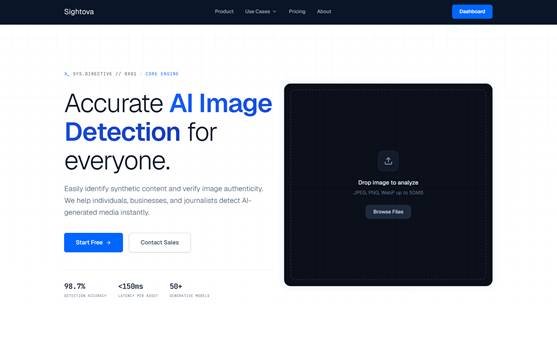
sightova.com flags AI-generated, tampered, NSFW, and violent imagery in milliseconds
Outcome: the seller’s dispute appeal was denied, and the marketplace restricted the account. The buyer got refunded. The real lesson wasn’t that “AI is bad,” it was that high-resolution, studio-looking “proof” is now a reason to investigate, not a reason to relax.
Case 3: The “Breaking News” Protest Photo That Didn’t Match the Street
A dramatic image started circulating during a tense local protest. It showed a crowd, a banner with a slogan that matched the moment, and a police line in the background. The caption claimed it was taken “just now” outside city hall.
Reporters got tagged. Community accounts reposted it. The scene fit the narrative so well it felt like confirmation, not information.
Then someone who lived nearby noticed a mismatch: the building façade in the background didn’t match city hall. Similar, yes. But the windows were wrong. Another person pointed out the street signage was a jumble of plausible letters, not actual words.
This is a classic giveaway with synthetic images: text and fine geometry often look right at first glance but fall apart under scrutiny. Even when models have improved, they still struggle with consistent lettering and specific architectural details.
A newsroom photo editor pulled the image into their verification workflow. They checked for prior instances of the same scene. Nothing. Then they looked for camera artifacts common to phone photography: sensor noise patterns, consistent depth cues, natural motion blur. The image looked clean in the wrong way, like it was rendered instead of captured.
An AI detection pass pushed it over the line from “suspicious” to “reject.” The photo did not come from the protest. It was likely generated to feed the moment.
Outcome: the newsroom refused to publish it and posted a correction warning readers about the fake. The image still lived on in group chats, of course. But it didn’t make it into the news cycle as “confirmed,” which is often the difference between a hoax and a headline.
Case 4: The NSFW “Leak” That Tried to Blackmail a Small Creator
This one was messy, and unfortunately common.
A small content creator received an anonymous email: pay up or explicit images get posted. The images looked like the creator, same hairstyle, similar body type. The sender included a cropped face close-up and a second image that showed more context. They also referenced personal details pulled from public posts, to make the threat feel specific.
The creator insisted the images weren’t real. Friends weren’t sure. The attacker was betting on that uncertainty.
Detection tools that flag not only synthetic media but also NSFW content are built for this exact intersection, where verification and safety overlap. The giveaway here was subtle: the face resembled the creator but didn’t match known photos in micro-details. The skin texture looked smoothed, as if it had been painted on. Earrings that should have been symmetrical weren’t. Lighting on the jawline didn’t line up with the neck.
A verification run flagged the images as AI-generated, and the creator’s team documented the result for a police report and for platform moderation. That documentation mattered. When platforms see “here’s what I know and here’s what I checked,” they tend to move faster than when they get a panicked message with no supporting detail.
Outcome: the blackmailer lost leverage once the images were labeled as synthetic. The creator still had to deal with stress and cleanup, but the threat didn’t escalate into viral “leaks” with the same force, because the verification story traveled with the images.
Case 5: The Altered Document Scan in a Loan Application
Not all fakes are flashy. Some are just a number changed from “3,200” to “8,200.”
A lender reviewing a loan application received a scan of a bank statement. At first glance, it looked ordinary: consistent font, neat layout, normal transaction rows. The applicant’s income line looked healthy enough to qualify.
But the underwriter noticed a small inconsistency in the spacing between digits on one key line, like someone had nudged a character. That’s the kind of thing humans spot when they’ve stared at thousands of similar documents. It’s also why document fraud keeps getting caught by the dullest details.
Document tampering detection looks for signs of patching: localized compression changes, mismatched noise, edge halos around edited areas, and font artifacts that don’t belong. A scan produced on a home printer has a certain messiness. When someone edits a PDF or an image and re-exports it, the messiness becomes uneven.
The tampering check flagged the income line as edited. A follow-up request for original statements (direct from the bank portal, not a forwarded scan) confirmed the applicant’s submitted version had been altered.
Outcome: the application was denied, and the case was logged for fraud prevention. That “one edited line” would have had a real cost if it slipped through, not just for the lender but for anyone whose rates are shaped by default risk.
What These Five Cases Have in Common
- They hijack familiar formats. Chats, product photos, protest images, intimate pictures, bank statements. Things people think they already understand at a glance.
- They rely on speed. The fake wins if it gets shared before anyone asks, “Where did this come from?” The moment someone slows down, the weak points start popping.
- They mix technical tells with human pressure. A fraudster doesn’t need perfect pixels if they can trigger anger, fear, or urgency. That emotional shove is part of the design.
- Detection works best as a process, not a button. The strongest outcomes came when teams combined basic verification (source, context, inconsistencies) with automated detection for synthetic media or tampering.
The uncomfortable truth is that we’re entering a time when “I saw the screenshot” means almost nothing. The more practical truth is that fakes still trip over reality. Lighting that doesn’t behave. Text that isn’t quite language. Documents that lose their natural noise.
The people who catch them aren’t usually geniuses. They’re just the ones who pause long enough to look.